Project Detail
Flow Over Cylinder: Vortex Shedding Study
A two-case CFD study simulating flow over a circular cylinder using ANSYS Fluent in both steady-state and transient modes. The study characterises von Kármán vortex shedding at Re = 100 and calculates the Strouhal number from the transient velocity-time signal.
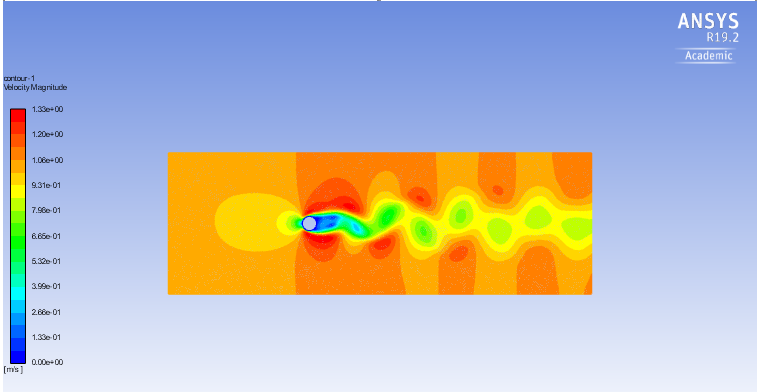
Background: Von Kármán Vortex Shedding
When a bluff body like a cylinder is placed in a uniform flow, the boundary layer separates periodically from the upper and lower surfaces, creating an alternating pattern of counter-rotating vortices downstream, a von Kármán vortex street.
This phenomenon governs:
- Structural loading on offshore risers, bridge cables, and heat exchanger tubes, the periodic shedding creates oscillating lift forces that can drive resonance
- Heat transfer, the vortex street enhances convective mixing downstream of the cylinder
- Flow-induced noise, the shedding frequency sets the dominant acoustic tone in bluff-body flows
Von Kármán vortex streets form in laminar flow when 40 < Re < 100. Reynolds number is controlled here by fixing geometry and velocity while tuning dynamic viscosity.
Strouhal number (St) is the dimensionless measure of shedding frequency:
St = fL / U, where f = shedding frequency, L = characteristic length (cylinder diameter), U = free-stream velocity
St values between 0.2 and 0.4 indicate oscillation-dominated flow.
Mesh Setup
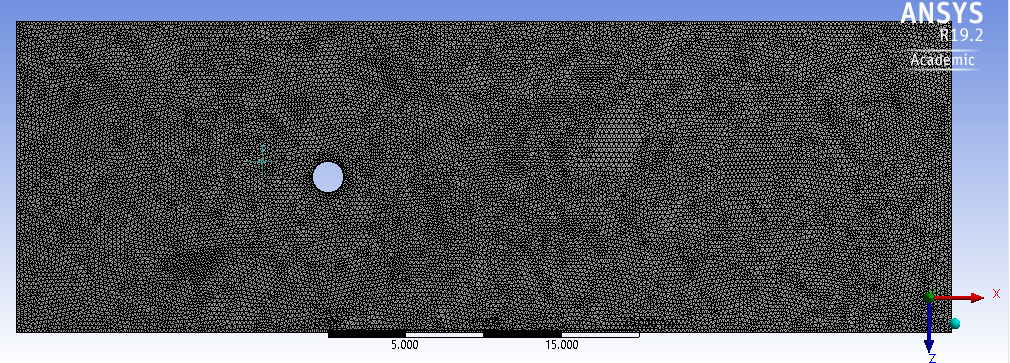
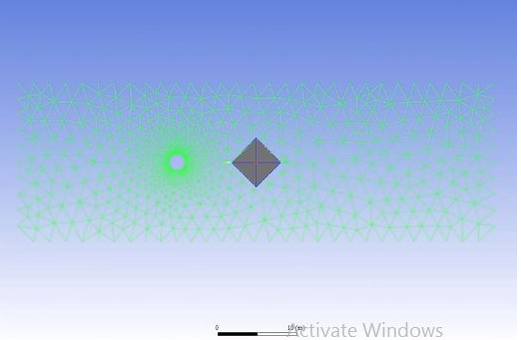
A triangular mesh was used throughout the domain to accurately resolve the curved cylinder surface and capture the vortex wake. An inflation layer was applied around the cylinder wall to increase near-wall resolution, critical for correctly predicting separation point and shedding onset.
Simulation Parameters
| Parameter | Value |
|---|---|
| Cylinder diameter (L) | 2 m |
| Free-stream velocity (U) | 1 m/s |
| Air density (ρ) | 1 kg/m³ |
| Dynamic viscosity (μ) | 0.02 kg/m·s |
| Reynolds number (Re) | 100 |
| Mesh element size | 0.25 mm |
| Solver type | Pressure-based |
| Working fluid | Air |
Re = ρUL/μ = (1 × 1 × 2) / 0.02 = 100, within the laminar vortex-shedding regime.
Case 1, Steady-State Solver
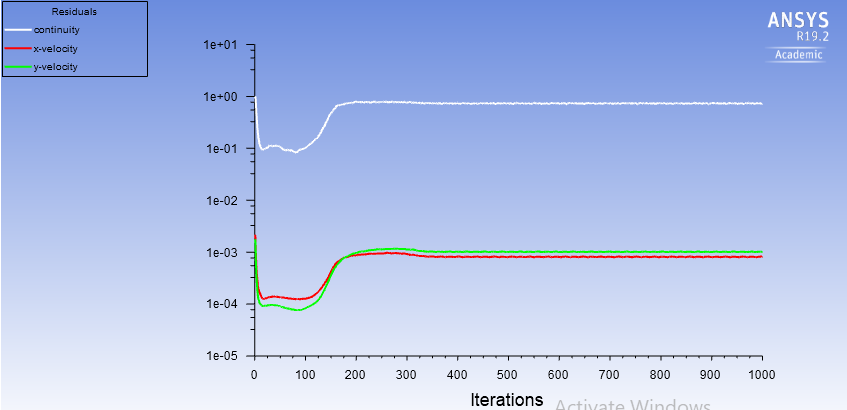
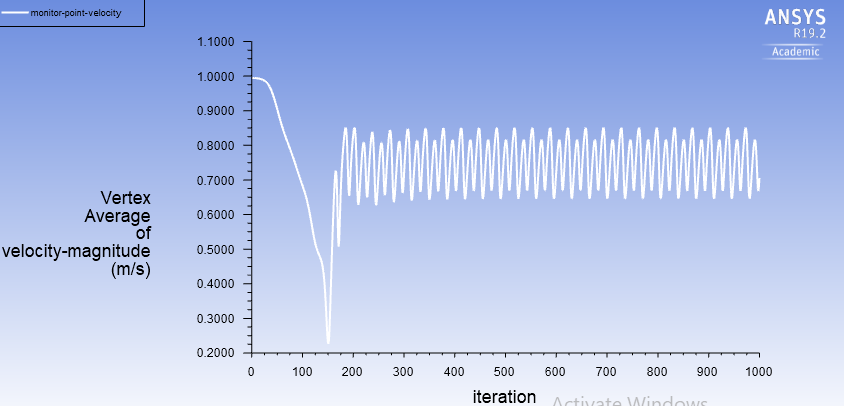
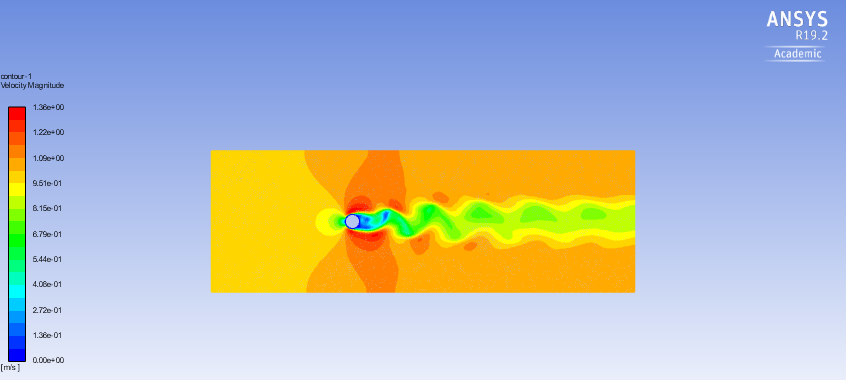
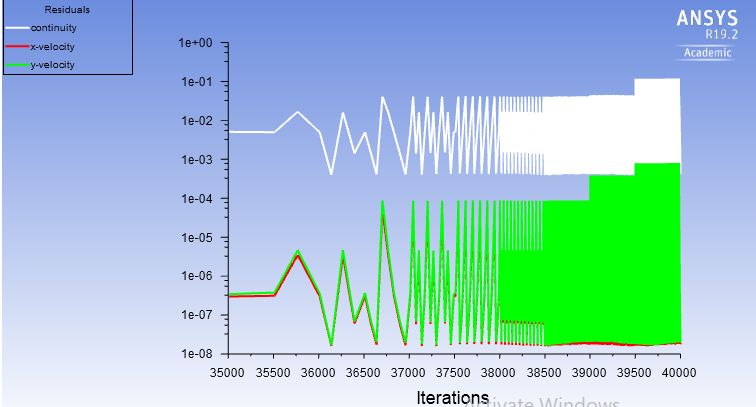
The steady-state solver computes a time-averaged solution. For vortex shedding problems this is a deliberate choice: a steady solver cannot properly converge an inherently unsteady flow, so the oscillations in the residuals and monitor signal reveal the shedding physics rather than hiding them.
Run: 1000 iterations
Case 2, Transient Solver
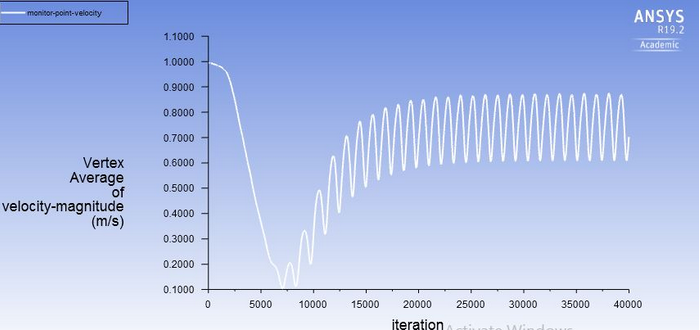
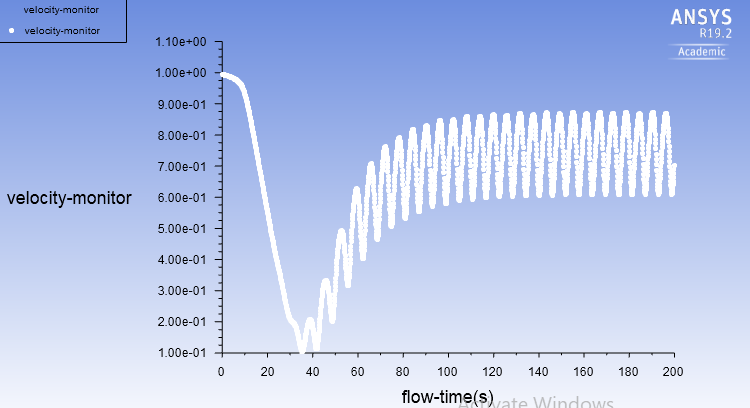
The transient solver resolves the time-dependent flow field step by step, capturing the actual vortex formation, growth, and shedding cycle. This is the physically correct approach for shedding problems and the only mode from which a meaningful Strouhal number can be extracted.
Results & Strouhal Number
Key findings
Steady solver detects shedding but cannot quantify it. The oscillating residuals and velocity monitor confirm that vortex shedding is occurring, but without a resolved time axis the shedding frequency cannot be reliably extracted, Strouhal number is indeterminate from steady results.
Transient solver resolves the shedding cycle fully. The velocity-time signal converges to a stable periodic oscillation after ~120 s of flow time, giving a clean frequency measurement.
Strouhal number confirms oscillation-dominated flow. St = 0.36 falls within the 0.2-0.4 range expected for Re = 100, validating both the mesh setup and the transient solver configuration.
| Case | Solver | Shedding Visible | St Calculable | St Value |
|---|---|---|---|---|
| 1 | Steady-state | Yes (oscillating residuals) | No | , |
| 2 | Transient | Yes (resolved cycles) | Yes | 0.36 |
Strouhal number calculation, Case 2:
f = 11/60 Hz · L = 2 m · U = 1 m/s
St = fL/U = (11/60 × 2) / 1 = 0.367 ≈ 0.36
Since 0.2 < St < 0.4 → oscillation dominates the flow, consistent with Re = 100 vortex-shedding regime.